Most Shopify stores run on paid ads. Meta campaigns, Google Shopping, influencer posts — all of it works until it stops. The moment you pause the spend, the sales disappear. There’s no asset left behind. You’re renting traffic, not building it.
The Shopify stores that quietly print revenue for years without a daily ad budget aren’t running some secret campaign strategy. They’ve built something more durable: organic search traffic through product-focused blog content.
This guide explains exactly how product description blogging and buyer-intent content creation drives compounding organic sales on Shopify — and why the stores investing in content now will own their categories in three years.
Why Paid Ads Alone Is a Losing Game for Shopify Stores
The economics of paid e-commerce advertising have shifted dramatically. iOS privacy changes gutted Meta targeting precision. Google Shopping competition drives up CPCs every quarter. Return on ad spend (ROAS) that was 4x two years ago is now 2x for many stores — and trending down.
Meanwhile, organic search traffic is free, compounds over time, and isn’t subject to algorithm changes in your ad account or iOS policy updates. A blog post that ranks #1 for “best for [use case]” in 2025 will still be driving traffic in 2028.
According to Shopify’s official SEO guide, organic search is consistently one of the top revenue channels for mature e-commerce brands — and content is the primary driver of organic growth. Yet most Shopify store owners treat their blog as an afterthought.
The Keyword Types That Drive Organic Sales (Not Just Traffic)

There’s a critical distinction between keywords that drive traffic and keywords that drive sales. A Shopify store’s SEO strategy needs to focus on the latter — buyer-intent keywords.
1. “Best [Product] for [Use Case]” Keywords
These are the highest-converting content keywords in e-commerce. Someone searching “best yoga mat for bad knees” or “best coffee grinder for espresso under $100” is done browsing — they’re ready to buy. They just need someone to make the recommendation.
A blog post that answers this query comprehensively, includes your product (ideally in the top recommendation), and links directly to your product page will convert at a rate that rivals your best paid campaigns.
2. “How to Choose [Product]” Keywords
These target shoppers in the consideration phase:
- “How to choose a standing desk for home office”
- “What to look for when buying a weighted blanket”
- “How to choose the right kayak for beginners”
A buying guide that explains the key decision factors — weight, size, material, price range — and then presents your product as the answer to those criteria is a powerful sales tool. You’re not selling; you’re educating. But the education leads directly to a purchase.
3. Product Comparison Keywords
- “[Your product] vs. [competitor product]: Which is better?”
- “[Product type] comparison: 5 options reviewed”
Comparison content is extremely high-intent. If someone is comparing two specific products, they’re minutes away from a purchase decision. Even if you don’t carry the competitor’s product, a comparison post that highlights your product’s strengths can capture that search traffic and redirect it to your store.
4. Problem-First Keywords
- “How to sleep better with chronic back pain” (→ leads to orthopaedic pillow)
- “How to keep a dog calm during thunderstorms” (→ leads to anxiety wrap)
- “How to organize a small kitchen” (→ leads to storage products)
Problem-first content reaches buyers before they know what product they need. You solve the problem, introduce the solution, and present your product as the vehicle. This is top-of-funnel content with bottom-of-funnel intent.
Collections Pages and Category SEO: The Overlooked Opportunity
Shopify’s collection pages are often the highest-value SEO real estate on the entire store — but they’re almost never optimized. A collections page for “Men’s Running Shorts” with no text, no descriptions, and no internal linking is leaving significant ranking potential on the table.
Blog content can support collections pages in two key ways:
- Internal linking: Every “best running shorts for [use case]” blog post links to your collections page, building authority to that page over time.
- Content clusters: A pillar post (“The Complete Guide to Running Shorts”) becomes the hub that links to multiple supporting posts (“running shorts for trail running,” “running shorts for hot weather,” “compression shorts vs. regular shorts”) — all interlinking back to your collections page.
This content cluster structure is how Shopify stores that rank for broad category terms build their authority. It’s not one great post — it’s a network of related posts that collectively tell Google: this store is the authority for this product category.
Product Page SEO vs. Blog Content: Understanding the Difference
A common mistake: trying to rank product pages for informational keywords. Product pages are designed to convert — they should target transactional keywords (“buy [specific product],” “[brand]
“). They’re not designed for ranking on “how to choose” or “best ” queries.That’s exactly what blog content is for. The traffic funnel works like this:
- Blog post ranks for “best yoga mat for hot yoga”
- Reader finds your recommendation compelling
- Internal link sends them to your Yoga Mat Collections page or specific product page
- Product page converts them into a buyer
Each piece of content has a job. Blog posts attract and educate. Product pages convert. They work together — not in competition.
The Compounding Effect: Why Early Investment Pays Long-Term
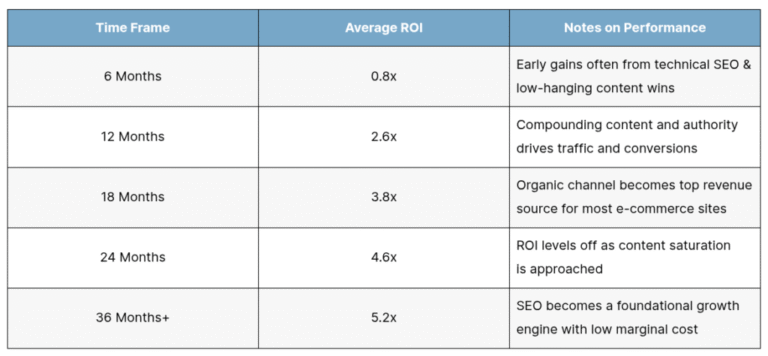
Content marketing for Shopify is not a quick win — but it is a reliable one. Here’s what the timeline typically looks like for a store starting from scratch:
- Month 1–2: Publishing content, Google begins indexing
- Month 3–4: Long-tail posts start appearing in search; first organic sessions
- Month 5–6: Multiple posts on pages 2–3; traffic beginning to accumulate
- Month 7–9: Page 1 rankings for lower-competition terms; organic revenue appears
- Month 10–12: Content flywheel kicks in; each new post benefits from the authority built by previous posts
After 12–18 months of consistent publishing, many Shopify stores find that organic traffic requires no additional investment to maintain — it simply compounds. Ahrefs’ e-commerce SEO research consistently shows that stores with 50+ indexed blog posts see dramatically higher domain authority and ranking velocity for new content compared to stores without a content strategy.
Practical Tips for Shopify Blog SEO

- Target one primary keyword per post. Don’t try to rank for five things. One post, one main keyword, thorough coverage.
- Use your keyword in the H1, first paragraph, and at least one H2. Don’t stuff — just place naturally.
- Add product links with descriptive anchor text. “Shop our yoga mat collection” converts better than “click here.”
- Include real product images. Blog posts that feature your actual products (with alt text) double as product discovery tools.
- Target long-tail variations. “Best yoga mat for beginners” is less competitive than “best yoga mat” and converts better because the intent is clearer.
- Publish consistently. Two posts per month beats five posts in January and none for six months.
This is where a done-for-you content subscription like RankOnRepeat pays for itself — your publishing cadence stays consistent regardless of how busy your store operations get.
Frequently Asked Questions
Does Shopify SEO actually work without a huge domain?
Yes — especially for long-tail and niche product keywords. New Shopify stores can rank on page 1 for specific queries like “best for [very specific use case]” within 3–4 months, even without strong domain authority. The key is targeting achievable keywords first and building from there.
How many blog posts does a Shopify store need before seeing results?
Most stores start seeing meaningful organic sessions at 15–20 published posts. The quality and targeting of those posts matters more than the quantity — 15 highly targeted, well-optimized posts will outperform 50 thin, generic posts every time.
Should I focus on blogging or fixing my product pages first?
Both — but start with product pages. Make sure your product titles, descriptions, and meta data are optimized before building your blog content strategy. Blog traffic that lands on a poorly optimized product page won’t convert. Once product pages are solid, layer in blog content to drive traffic to them.
How is RankOnRepeat different from hiring a freelancer?
RankOnRepeat is a subscription service that handles keyword research, writing, optimization, and publishing on a recurring monthly basis — no project management, no briefs to write, no back-and-forth. Compare plans here.
Stop Renting Traffic. Start Building It.
Paid ads are a tool — but they’re not an asset. Every dollar you spend disappears when the campaign stops. Blog content is an asset that grows in value over time, drives compounding returns, and doesn’t require ongoing spend to maintain its traffic.
The Shopify stores winning on organic search in 2026 started publishing in 2024. The stores that start today will own their categories in 2027. The best time to start was last year. The second best time is now.
RankOnRepeat publishes SEO blog content for Shopify stores every month — buyer-intent posts, buying guides, product comparisons, and collection page support. All researched, written, optimized, and published for you. See how the subscription works.
[1] Shopify — The Complete Guide to E-commerce SEO — Official Shopify resource on organic search strategy for online stores.
[2] Ahrefs — E-commerce SEO: The Beginner’s Guide — Research-backed analysis of content strategy and domain authority for online stores.
[3] Google Search Central — Product Structured Data — Google’s guidance on product markup for e-commerce SEO.
Want content like this working for your business? RankOnRepeat writes, publishes, and manages your entire blog — keyword-targeted articles that attract clients and rank on Google, hands-free. Get started today → · Browse content samples
Real example: HawaPets.com — a pet clothing and accessories store — uses blog content to attract dog owners searching for breed-specific care and style advice, turning readers into repeat buyers.