KEY TAKEAWAYS
- Cosmetic surgery Google Ads cost $18–$45 per click — among the priciest verticals in paid search, and the click does not buy a booking.
- An ASPS member practice averages roughly $1.7M in annual cosmetic revenue, but most patients quietly research the surgeon for weeks on Google before they ever pick up the phone.
- Blogs that rank for procedure-specific questions get found during research, not bidding wars — and once a page ranks, every click costs you nothing.
- You cannot outrank RealSelf head-on. You can outrank it on the long tail (your city + procedure + concern) where directories give shallow answers.
- Expect 90–180 days to see traction. Practices that ship 2–4 posts weekly start showing meaningful organic consult requests by month 4–6.
Table of Contents
- The Cosmetic Surgery Google Problem Nobody Talks About
- Why Paid Ads Punish Plastic Surgeons More Than Other Specialties
- The Actual Patient Journey From Search to Consultation
- The Content Categories That Actually Convert
- Before-and-After Galleries Are Not Enough
- How to Compete With RealSelf and Healthgrades on the Long Tail
- The Trust Signals Google Wants in Cosmetic Medical Content
- How Long It Takes to See Real Results
- The Compliance Layer You Cannot Skip
- Frequently Asked Questions
A breast augmentation patient is worth somewhere between $7,500 and $14,000 to a typical plastic surgery practice. A rhinoplasty case lands in the same neighborhood. That same patient, before booking, types something into Google. If your practice is not on the first page for what they typed, they are not your patient — they are a competitor’s.
Cosmetic surgery is one of the most expensive specialties to advertise in. The clicks are not cheap, the conversion windows are long, and Google’s medical content rules are stricter than they are for almost any other industry. Blogging is the way out — but only if it is done with a real understanding of how cosmetic patients search, what they need to read before they call, and why most surgeon websites look identical to Google.
The Cosmetic Surgery Google Problem Nobody Talks About
Most plastic surgery websites are built once, by a vendor, around photo galleries and procedure pages that read like medical brochures. Then they sit. The “blog” tab has six posts from 2019 and a Christmas card from the office manager. Google sees that and treats the site like a closed restaurant — there is a sign on the door, but nobody is home.
Meanwhile, RealSelf, Healthgrades, and a dozen aggregator sites publish hundreds of articles a month. They show up for every procedure question a prospective patient could ask. When that patient eventually books with a surgeon, the directory got the credit, the surgeon paid the lead fee, and the relationship started on someone else’s platform.
The honest truth: a quiet website is a tax that plastic surgeons pay forever. Every month it sits dormant, the gap between you and the directories gets wider.

Why Paid Ads Punish Plastic Surgeons More Than Other Specialties
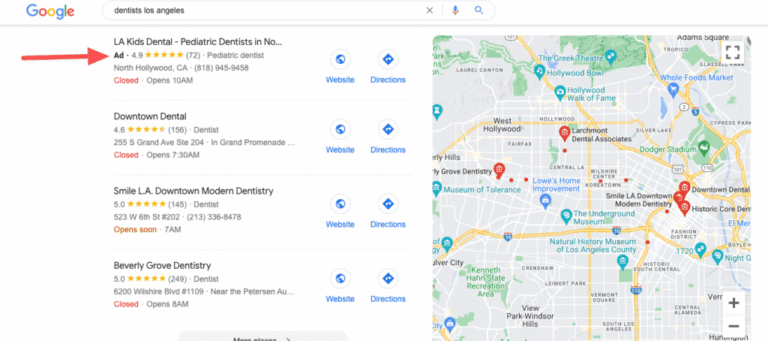
The keyword “plastic surgeon near me” runs between $18 and $45 per click on Google Ads, depending on the city, according to publicly available CPC tools. “Rhinoplasty” in a major metro can clear $30. Compare that to “general dentist” at around $6–$10, and you start to see why aesthetic medicine is in a class of its own.
Here is the cost stack most surgeons do not run the numbers on. If you are paying $30 per click and converting consultation requests at 4%, your cost per consultation is $750. Roughly one in three consultations books a procedure. That puts your patient acquisition cost north of $2,200 before you have done a single thing surgical. That math works at $14,000 case values. It does not work nearly as well for a $3,000 filler patient — which is why the practices doing best on paid ads are the ones doing high-ticket procedures and ignoring the lower revenue work.
Organic content flips the math. The post that ranks for “best age for rhinoplasty” or “how long does a brow lift last” was paid for once. The 800th visitor reading it next year costs nothing. Dental practices figured this out a few years ago, and aesthetic medicine is catching on now.
The Actual Patient Journey From Search to Consultation
Cosmetic patients are not impulse buyers. The American Academy of Facial Plastic and Reconstructive Surgery has documented research windows that routinely stretch 6 to 18 months from first search to first consultation. During that window, the average patient visits 7–10 different sites.
The searches change at each stage:
- Awareness: “Can a nose job be reversed?” — “Is liposuction worth it?” — “Does Botox cause permanent damage?”
- Consideration: “Rhinoplasty recovery week by week” — “Tummy tuck vs liposuction” — “Average cost of breast augmentation 2026”
- Decision: “Best rhinoplasty surgeon Dallas” — “Plastic surgeon reviews Scottsdale” — “Dr. [Name] before and after”
If your only content is procedure pages aimed at decision-stage searches, you are invisible to that patient for 95% of their research. By the time they get to “best plastic surgeon in [city],” they have already short-listed three names — and those three are the ones whose blog posts they read at every earlier stage.
The Content Categories That Actually Convert
Forget “general topics about plastic surgery.” The categories below are the ones that turn organic visitors into consultation bookings. They map directly to the patient journey above.
Procedure deep-dives. One post per procedure, 2,000+ words, written like a friend with a medical background is walking the patient through it — not like an insurance pamphlet. Cover anatomy, candidacy, what happens during, recovery week by week, scarring, results timeline, who should not do this. These are evergreen anchor pages.
A direct answer for the featured snippet: The best cosmetic surgery blog content does three things: it answers the procedure questions patients are afraid to ask their surgeon, it shows clinical judgment without giving medical advice, and it gets updated when techniques evolve.
“Versus” comparisons. Botox vs Dysport. Mini facelift vs full facelift. Smartlipo vs traditional lipo. These keywords have buyer intent baked in — patients are not searching for a comparison unless they are actively shopping.
Cost transparency posts. Most surgeons hate publishing prices. But cost questions are the second-most-searched cosmetic queries after “before and after” images. A practice that publishes thoughtful cost ranges with the variables that move the number (“rhinoplasty cost depends on whether it is functional, revision, or ethnic”) gets the click. The ones that bury price get skipped.
Recovery and downtime content. “How long is the recovery for a tummy tuck” is searched roughly 8,100 times per month in the US, per Ahrefs data. That is a working professional figuring out if she can take three weeks off in August. Be the surgeon who answers her question and you are on her short list.
Concern-driven content. “How to fix asymmetric breasts after pregnancy.” “What can be done about a hooked nose.” Patients describe problems, not procedures. Match their language and you intercept them before the directory does.
Before-and-After Galleries Are Not Enough
Every cosmetic surgery website has galleries. Galleries are table stakes — they are not a ranking factor. Google cannot read what is in the photo, only the captions and alt text around it. A site with 400 unlabeled before-and-after images and zero written content is competing on aesthetic appeal alone, which makes patient choice come down to whose photographer was better.

The galleries that do rank pair every set of photos with a case story: patient demographic (age range, no identifying detail), what they wanted addressed, what was technically done, recovery notes, and the patient’s quote at follow-up. Now Google has 300 words of indexable content per case. Multiplied across 50 cases, that is a small site’s worth of unique, surgeon-authored content that no directory can replicate.
How to Compete With RealSelf and Healthgrades on the Long Tail
Trying to rank for “rhinoplasty” against RealSelf is a fight you will lose. They have a 15-year head start, thousands of doctor-answered Q&As, and a domain authority north of 80. The smart play is the long tail — keywords with 100–500 monthly searches where directories give vague, copy-paste answers and a real surgeon’s blog post can answer with specifics.
The pattern: [city or region] + [procedure or concern] + [specific question]. “Revision rhinoplasty after septoplasty failure in Houston.” “Mommy makeover financing options Phoenix.” “Diep flap reconstruction surgeons Bay Area.” Each individual phrase brings ten searches a month. Stack 200 of them and you have a steady drip of high-intent traffic that directories cannot intercept because directories do not write at that specificity.
Dental practices that figured out the long tail are now booking more new patients from search than from referrals. The same playbook works for aesthetic medicine — better, actually, because cosmetic patients research more obsessively.
The Trust Signals Google Wants in Cosmetic Medical Content
Cosmetic surgery falls under what Google calls Your Money or Your Life content. The quality rater guidelines, available publicly on Google Search Central, demand that medical content show first-hand experience and verified expertise. In practice that means three things on every page.
First, a real surgeon byline. A page authored by “Admin” or “Clinic Team” gets discounted. Pages authored by Dr. Jane Smith, MD, FACS, with a link to her credentials page, get treated as authoritative. Make every post have a real attributed author.

Second, “reviewed by” or “last updated” timestamps on clinical content. Patients want to know the recovery timeline they are reading reflects 2026 techniques, not 2014. Google wants to know too.
Third, internal links between procedure pages, blog posts, and the surgeon’s credentials. A page about a rhinoplasty technique should link to the surgeon’s training history, board certification, and the gallery for that specific procedure. This is what Google calls topical authority, and it is the single largest ranking factor most medical sites ignore. Real-world proof: a Taipei service business managed through daily SEO content grew from zero to over 1,100 monthly organic visitors in under a year using exactly this internal-linking discipline.
How Long It Takes to See Real Results
Anyone promising rankings in 30 days is selling fairy dust. Aesthetic medicine is a competitive, established niche on Google. New domains take longer than established ones. Backlinko’s 2024 analysis of 11.8M Google results found that the average page that ranks in the top 10 is just over 2 years old.
A realistic timeline looks like this:
- Month 1–3: Posts indexed, ranking for ultra-long-tail queries with low traffic. Some hits, lots of patience required.
- Month 4–6: Long-tail keywords climbing into the top 10. First organic consultation requests start showing up in patient intake forms.
- Month 7–12: Mid-tail keywords (your city + procedure) ranking. Patients reference specific blog posts during consultations.
- Year 2+: Compound traffic. The 60 posts you have published are now linking to each other, accumulating backlinks, and serving as the trust layer that makes consultations close faster.
The practices that quit at month 3 are the reason the practices who do not quit win. This is not a productivity problem — it is a discipline problem, and it is solved by treating publishing as non-negotiable, not as something to fit in between cases.
The Compliance Layer You Cannot Skip
HIPAA, state medical boards, and the FTC all watch cosmetic surgery marketing. The mistakes that get practices in trouble are not subtle. Promising results, guaranteeing outcomes, posting patient photos without written consent, using “best” without substantiation, comparing yourself to a named competitor — any of these can trigger a complaint that turns into a board investigation.
The compliance-safe content frame is straightforward: describe procedures, candidacy criteria, recovery, and risks accurately. Use phrases like “patients often experience” instead of “you will see.” Show outcomes without claiming them as typical. Have every post reviewed by the surgeon or a credentialed staff member before publishing. The same content rules that govern therapists writing about mental health apply here in spirit, even if the specific regulatory bodies are different.
If a content vendor is writing for you without showing you compliance review steps, that is the vendor to fire first. The cost of a board complaint dwarfs the cost of any content service.

Frequently Asked Questions
How many blog posts does a plastic surgery practice need to start ranking on Google?
A working baseline is 50–80 published posts before you have enough topical depth to rank for competitive procedure terms. Most practices get there in 6–12 months of consistent publishing at 2–4 posts per week. Below 30 posts, Google does not see you as authoritative on the topic.
Can I use AI to write my plastic surgery blog content?
Yes, but it has to be reviewed and edited by a credentialed person before publishing. Google does not penalize AI-assisted content. It penalizes generic, unverified, low-effort content. The line is editorial care, not the tool used. Letting AI publish raw drafts under a surgeon’s byline is the version that gets practices in trouble.
Should I publish my surgical fees online?
Publish ranges with the variables that move the price. “Rhinoplasty in our practice ranges from $8,500 to $14,000 depending on whether functional correction is included” is honest, useful, and ranks. Hidden prices push patients to call competitors who answered the question first.
Will blogging help my Google Business Profile rank too?
Yes. Google uses content from your website to interpret what your Business Profile is about. A site with 80 procedure-specific posts feeds your profile much stronger topical signals than a thin site with five pages, which is a major factor in local map pack rankings.
Stop Paying $30 a Click for Patients Who Were Already Researching You
The plastic surgeons who will own search five years from now are the ones publishing now. Every blog post is an asset that compounds — it earns backlinks, picks up featured snippets, gets cited by AI search tools, and slowly pulls ranking authority from your competitors. The ones still relying on paid ads alone will spend more each year for the same volume of leads as click costs continue climbing.
If publishing 2–4 procedure-specific posts a week sounds like a job nobody on staff has time for, that is exactly what RankOnRepeat handles — keyword research, surgeon-byline-ready writing, image sourcing, and publishing straight to your site, for a flat monthly fee. The full process is laid out in how it works.
References
- American Society of Plastic Surgeons — Procedural Statistics — annual procedure volume and revenue data for ASPS member practices.
- American Academy of Facial Plastic and Reconstructive Surgery — patient research behavior surveys for cosmetic and facial procedures.
- Google Search Central — Creating Helpful, People-First Content — Google’s official quality and E-E-A-T guidance for medical content.
- Backlinko — Search Engine Ranking Factors — 11.8M-result analysis on average age of top-ranked pages and ranking signals.
- Ahrefs Keywords Explorer — monthly search volume data for cosmetic surgery query patterns referenced throughout.
- BrightLocal — Local Consumer Review Survey — local search and review behavior data for service-based healthcare businesses.
Want content like this working for your business? RankOnRepeat writes, publishes, and manages your entire blog — keyword-targeted articles that attract clients and rank on Google, hands-free. Get started today → · Browse content samples
Published by the RankOnRepeat editorial team · Last updated: June 2, 2026 · How RankOnRepeat works