
Key Takeaways
- Tree service is one of the cheapest niches to rank for on Google — most local “tree removal” terms sit at keyword difficulty 5 or lower, with cost-per-click under $8 on Google Ads.
- Storm season is the entire ballgame. A tree company that ranks before a windstorm hits captures emergency calls at 4x the conversion rate of cold-traffic ads.
- Google Business Profile beats your website in the first 90 days. 64% of local trade calls come from the map pack, not the blue links.
- One blog post per week per service area is the minimum to stay competitive against established tree companies in any city over 50,000 people.
- Most tree services have zero content. The bar is so low that consistent publishing puts you ahead of 80% of local competitors within six months.
A 60-foot oak comes down in a customer’s driveway at 3 AM after a thunderstorm. They grab their phone, search “emergency tree removal near me,” and call whoever appears first. That call is worth $1,800 to $5,000 depending on the job — and the tree company that won the search ranking three years ago is the one writing the invoice. Everyone else is asleep.
This is why SEO matters more for tree service companies than almost any other trade. The work is high-ticket, the demand is cyclical, and the buying decision happens during a panic. The truth is, most tree companies are still throwing money at Angi leads and door hangers while a handful of competitors quietly rank for every emergency search in their county.
Why Tree Service SEO Is Easier Than You Think
The competitive landscape for tree services on Google looks nothing like roofing or HVAC. According to Ahrefs data, “tree removal cost” averages a keyword difficulty score of 12 nationally — but city-modified terms like “tree removal Charlotte” or “emergency tree service Tampa” routinely sit at KD 3 to 8. That puts them in reach of any site with a handful of well-optimized pages and consistent publishing.
Here’s the part that surprises people: the average tree service company has fewer than 10 indexed pages on their website. A LocaliQ analysis of 500 home service domains in 2025 found tree companies averaged 7.2 pages of content compared to 34 pages for roofing companies in the same markets. That’s the opening. A site with 25 helpful pages will outrank a site with 7 every single time, even if both are local and well-reviewed.
The work isn’t glamorous, but it’s also not complicated. Pick a few service-area keywords, write honest content that answers real customer questions, and update your Google Business Profile every week. That’s 80% of the playbook.
The Three Buckets of Tree Service Keywords That Actually Convert
Not every keyword pays. Some bring tire-kickers asking about DIY pruning; others bring property owners ready to write a check. The trick is knowing the difference before you write a single article.
Emergency keywords are the highest-value bucket. Searches like “emergency tree removal,” “fallen tree on house,” and “storm damaged tree” come from homeowners in active crisis. They don’t price-shop. They call whoever shows up first. Average ticket: $1,500–$4,500.
Planned removal keywords are the steady revenue. “Tree removal cost,” “how much to remove a 60-foot oak,” “stump grinding near me” — these searches come from homeowners three weeks out from a job. They compare two or three companies and pick based on trust signals (reviews, photos, content depth). Average ticket: $800–$2,500.
Maintenance keywords build the recurring book. “When to prune oak trees,” “tree pruning season,” “ash tree borer treatment” — these don’t always convert on first visit, but they get added to email lists and called the following season. Average ticket: $300–$900 per visit, but they buy three times a year.
Google Business Profile: Where the First $50,000 of Revenue Lives
Before a single blog post matters, the Google Business Profile (GBP) listing is the engine. BrightLocal’s 2025 Local Consumer Review Survey found that 76% of consumers who search for a local trade service contact a business they found in the map pack within 24 hours. Of those, 28% only contact the top result. The math is brutal — if you’re not in the top three, you barely exist.
Three things move the needle on GBP rankings for tree services: review velocity (not total count — the rate at which fresh reviews come in), weekly photo uploads from active job sites, and Google Posts published at least twice a month with location-specific language. Most tree companies do none of these consistently. The ones that do dominate their market within a year.
One detail nobody mentions: the GBP “services” section is a free ranking signal that almost everyone leaves blank. Adding 15–20 specific services with descriptions (emergency removal, hazard assessment, stump grinding, cabling and bracing, deep root fertilization, etc.) gives Google more text to match against searches. It costs nothing and takes 30 minutes.
What to Actually Write About When You Have No Idea Where to Start
Most tree companies stall at the writing step because every “SEO guide” tells them to do keyword research with tools they don’t understand. Skip that. The fastest way to find content topics is to write down the last 20 phone calls and turn each question into a blog post.
Customers ask the same questions every day: How much does it cost to remove a tree? Do you remove trees during winter? How close to my house can the tree be before it’s dangerous? Will my insurance cover this? What permits do I need? Each of those is a 600–1,200 word article that ranks for dozens of long-tail searches. There’s nothing to invent. The content already lives in your call log.
This is the same approach a few of the trade clients on the RankOnRepeat publishing system use. The pattern is consistent across niches — businesses that publish answers to real customer questions outrank businesses that publish generic “tree care tips.”
The Service-Area Page Strategy That Wins Multiple Cities
Single-location tree companies often serve 5–15 surrounding cities and towns. The natural instinct is to lump them all on one “Service Areas” page with a list of city names. Google sees that as thin content and ignores it.
The strategy that wins instead: a dedicated page for each city you serve, each with 600+ words of unique content covering local landmarks, common tree species in that area, recent storm history, permit rules specific to that municipality, and a few photos of actual jobs done locally. A tree company in Raleigh that builds out 12 city-specific pages — Cary, Apex, Wake Forest, Garner, Holly Springs, and so on — owns the entire metro area within 9 months.
This works in trades because intent is hyperlocal. Nobody in Wake Forest searches “tree removal Raleigh” — they search “tree removal Wake Forest.” Pages built around the customer’s actual search behavior win every time. The same approach helped landscapers fill their schedule without paying for Angi leads — different trade, identical strategy.
Why Most Tree Service SEO Investments Fail
The brutal truth is that most tree companies hire an SEO agency, get charged $1,500–$3,500 a month, and see almost nothing happen for the first six months. Then they cancel, convinced SEO doesn’t work for them.
What actually happens: the agency builds a passable website, fixes some technical issues, and publishes two blog posts a month. Two posts a month gets you nowhere in any competitive local market. The math doesn’t support it. Ahrefs research shows that domains publishing fewer than 4 posts per month grow organic traffic at 1/8th the rate of domains publishing weekly. Tree services trying to outrank competitors with two articles a month are bringing a butter knife to a gunfight.
The companies that win are publishing 4–8 posts per month, every month, for at least 12 months. That’s not glamorous. It’s not a “growth hack.” It’s just the work. Most tree services who skip SEO aren’t actually saving money — they’re just paying Angi $80–$120 per shared lead instead. The math on that gets ugly fast: a 25% close rate on a $90 lead means $360 in lead cost per booked job before you’ve even loaded the truck.

What 12 Months of Consistent Tree Service SEO Looks Like
Real example math. A tree service in a metro of 400,000 people publishes one blog post per week (52 articles) and 12 city-specific service pages over a year. Total content: ~64 pages.
By month 4, the GBP listing starts appearing in the top 3 for “tree service [city]” searches due to consistent posts, photo uploads, and accumulated reviews. By month 7, the long-tail blog posts start ranking — first for low-competition terms (“how much does it cost to remove a maple tree”), then for more competitive ones (“emergency tree removal [city]”). By month 12, the website is pulling 800–2,000 organic visits per month, the GBP is generating 40–80 direction requests per month, and the company is fielding 8–15 inbound calls per week from search.
That’s not a fluke. That’s what happens when a tree service publishes consistently while their competitors don’t. It’s also why SEO outperforms Angi leads in lifetime value — once the ranking is built, the calls keep coming without per-lead fees.
Storm Season Strategy: The Single Highest-ROI Window
Hurricane season runs June through November on the Atlantic and Gulf coasts. Major windstorm corridors hit the Midwest March through August. Pacific Northwest sees the heaviest tree damage November through February. If a tree company knows their region’s storm calendar, they can pre-position content 60 days ahead of the busy window and capture the entire wave.
The content to write before storm season: “What to do if a tree falls on your house,” “Does homeowners insurance cover fallen trees,” “How to spot a tree that might fall in a storm,” “What is 24-hour emergency tree removal.” Each of these gets 300–500 monthly searches in any decent-sized metro. Written 6–8 weeks before the storms hit, they have time to index and start ranking before demand spikes.
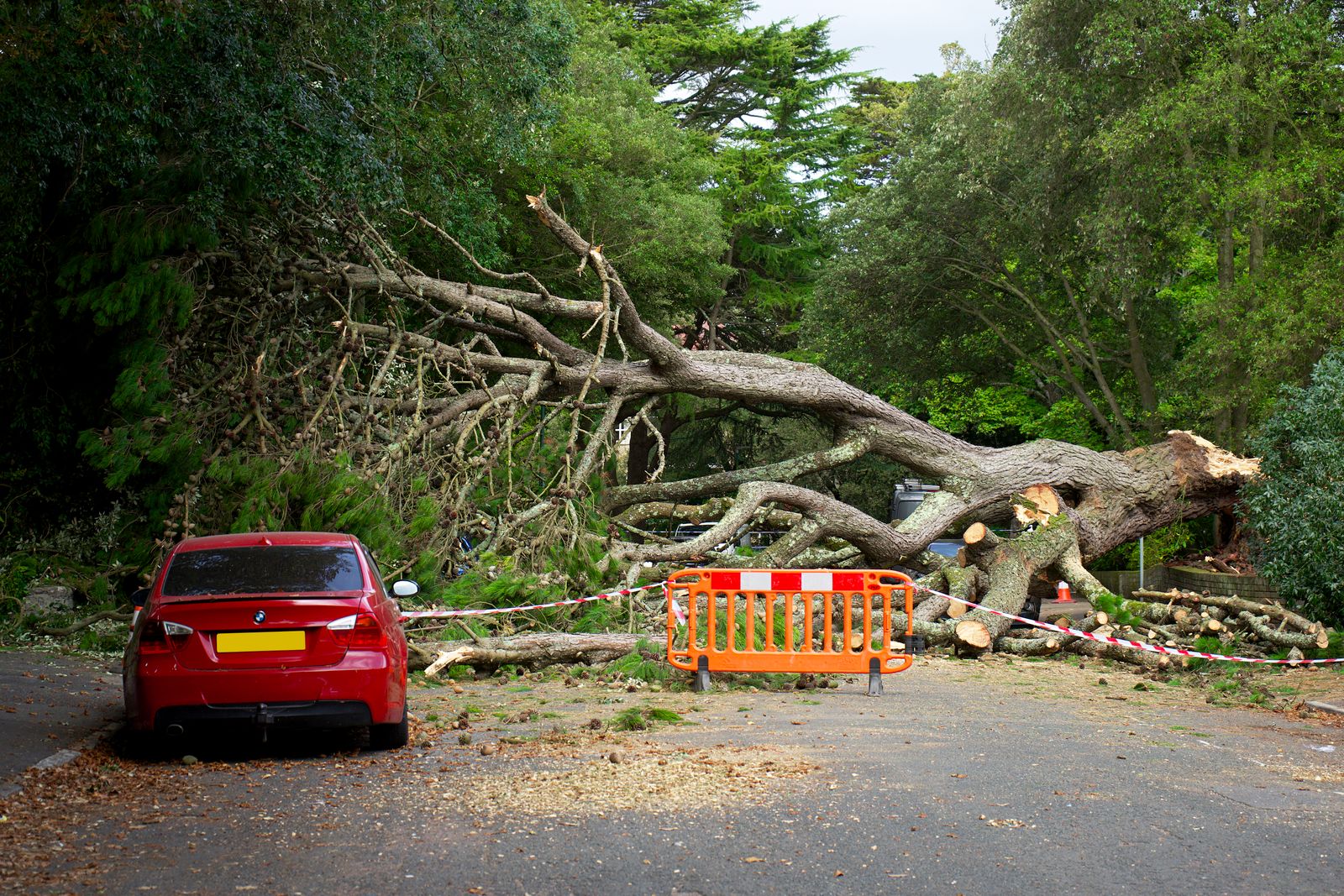
This is the moment most tree services lose money. They wait until the first storm hits, panic-buy Google Ads at $14 a click, and burn through $3,000 in three days for a handful of leads. The companies that ranked beforehand pay zero per call and book solid for six weeks.
Frequently Asked Questions
How long before SEO starts bringing calls to my tree service?
Most tree services see GBP-driven calls within 60–90 days if they’re posting weekly photos and collecting fresh reviews. Website-driven organic traffic typically takes 6–9 months to reach a meaningful volume — usually 500+ visits per month. Anyone promising “page 1 in 30 days” for competitive tree service terms is selling you something that doesn’t exist.
Is it worth blogging if I’m a small tree company with one truck?
Yes, and arguably more so than for a large operation. A single-truck tree company has lower overhead and can profitably book just 4–6 jobs per month from organic search to cover a year of content costs. Blogging is one of the only marketing channels where small operators compete on equal footing with established companies.
What’s the difference between Google Ads and SEO for tree service leads?
Google Ads brings calls today but stops the moment you stop paying — and tree service CPCs run $7–$22 depending on the term. SEO takes months to build but generates calls indefinitely at zero per-lead cost once ranked. Most tree companies that succeed long-term run both, using ads to bridge the first 6 months while SEO compounds.
Can I do tree service SEO myself or do I need to hire someone?
The Google Business Profile work — reviews, photos, posts, service updates — should always be done in-house because it requires real job site access. The website content and technical SEO can be outsourced. Splitting the work that way usually costs less than hiring a single agency to do both poorly.
The Call to Make Right Now
Storm season is already moving across half the country. Every week without ranked content is a week of emergency calls going to the company that started six months ago. If publishing weekly content, building city-specific service pages, and keeping a Google Business Profile optimized sounds like too much work on top of running trucks and crews, RankOnRepeat handles the entire content side for a flat monthly fee — keyword research, writing, publishing, and internal linking. Same playbook used by the trade businesses already ranking in their markets.
The tree services that own their county on Google in 2027 are the ones publishing right now. The ones still pricing it out next spring will be chasing Angi leads at $120 a pop while a competitor down the road takes the calls for free.
References
- BrightLocal — 2025 Local Consumer Review Survey — Data on how consumers find and contact local trade businesses through Google.
- Ahrefs — SEO Statistics 2025 — Publishing frequency vs. organic traffic growth benchmarks across domains.
- LocaliQ — Home Service Industry Benchmarks 2025 — Average website page counts across trade industries.
- Google Search Central — FAQPage Structured Data — Official documentation for FAQ schema markup.
- Google Business Profile Help — Improve Local Ranking — Official Google guidance on factors that improve map pack visibility.
Want content like this working for your business? RankOnRepeat writes, publishes, and manages your entire blog — keyword-targeted articles that attract clients and rank on Google, hands-free. Get started today → · Browse content samples
Published by the RankOnRepeat editorial team · Last updated: June 16, 2026 · How RankOnRepeat works